• Skip to primary navigation
  • Skip to main content
  • Skip to primary sidebar
  • Skip to footer
  • HOME
  • WHO WE ARE
    • About Our Firm
      • Communities We Serve
        • Kansas
          • Kansas City, KS
          • Lansing, KS
          • Leavenworth, KS
          • Leawood, KS
          • Lenexa, KS
          • Mission, KS
          • Olathe, KS
          • Overland Park, KS
          • Paola, KS
          • Prairie Village, KS
          • Shawnee, KS
          • Topeka, KS
        • Missouri
          • Gladstone, Mo
          • Independence, MO
          • Kansas City, MO
          • Lee’s Summit, MO
          • Liberty, MO
    • Attorney And Staff Profiles
    • Speaking Events
  • Estate Planning FAQs
    • Estate Planning Basics
    • Revocable Living Trusts
    • Trust Funding and Beneficiary Designations
    • Probate and Post-Death Administration
    • Real Estate, Deeds, and Trusts
    • Trustee and Executor FAQs
    • Business Interests, LLCs, and Special Assets
    • Digital Assets After Death
    • Guardianship, Conservatorship, and Court Questions
    • Working With Our Office
  • SERVICES
    • Asset & Business Planning
    • Estate And Gift Tax Figures
    • Family-Owned Businesses & Farms
    • Legacy Planning Services
    • Loss of a Loved One
    • Power of Attorney
    • SECURE Act
    • Special Needs Planning
    • Trust Administration & Probate
    • Young Families
  • Resources
    • Gladstone Elder Resources
    • Kansas City Elder Resources
    • Lenexa Elder Resources
    • Missouri and Kansas Elder Resources
    • Olathe Elder Resources
    • Overland Park Elder Resources
    • Estate Planning
      • An Overview of the Estate Administration Process
      • Estate Planning Checkup
      • Estate and Gift Tax Figures
      • Estate Planning Definitions
      • Estate Planning Reports
        • Advanced Estate Planning
        • Basic Estate Planning
        • Estate Planning for Niches
        • Trust Administration
      • Incapacity Planning Definitions
      • Is Your Estate Plan Outdated?
      • Top 10 Estate and Legacy Planning Techniques
      • Will vs. Trust: Which One Is Right for You?
    • Free Estate Planning Worksheet
    • Free Workshops
    • Frequently Asked Questions
      • Asset Protection Planning
      • Elder Law
      • Estate Planning
      • Estate Planning for Young Families
      • Estate Planning & Remarriage
      • Families Without an Estate Plan
      • Family Owned Business & Farm
      • Incapacity Planning
      • In Home Elder Care
      • IRA Inheritance Planning
      • Legacy Wealth Planning
      • LGBTQ Estate Planning
      • Living Trust
      • Medicaid Planning
      • Retirement & Pet Planning
      • Special Needs Planning
      • Trust Administration & Probate
      • Trusts
      • Wills
    • Presentations
    • Probate and Trust Administration
      • Probate Resources
        • Gladstone Probate
        • Kansas City Probate
        • Lenexa Probate
        • Olathe Probate
        • Overland Park Probate
      • Bereavement Resources
      • How to Know if You Need Extra Help With Your Grieving
      • Loss of a Loved One
      • The Mourner’s Bill of Rights
      • Things You Need To Do When a Loved One Passes Away With a Trust
      • Things You Need To Do When a Loved One Passes Away With a Will
      • Trust Administration Checklist
      • Trust Administration & Probate Definitions
    • Published Books
    • Video Resources
  • Workshops
  • Reviews
    • Our Reviews
    • Review us
  • CONTACT US
  • Blog

Gaughan & Connealy Estate Planning Attorneys

Creating Comprehensive Estate Plans in Kansas & Missouri

Connect with us today(913) 262-2000

Book Your Consultation
Home » Your Kids, Your Legacy, and the IRS: Why a Conduit Trust Might Just Be the MVP of Your Estate Plan

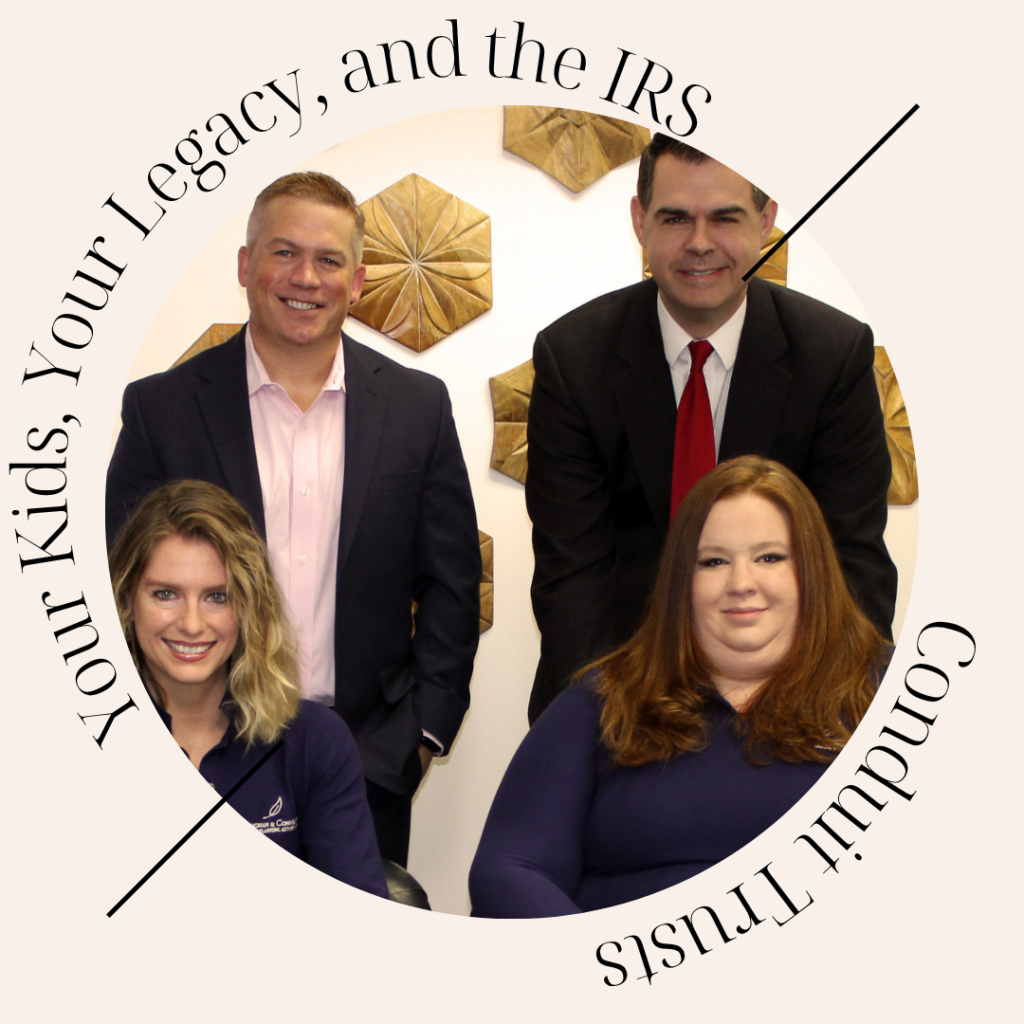
Your Kids, Your Legacy, and the IRS: Why a Conduit Trust Might Just Be the MVP of Your Estate Plan

June 18, 2025Estate Planning, estate taxation

Why a Conduit Trust Might Just Be the MVP of Your Estate PlanLet’s face it—nobody wakes up and says, “I can’t wait to figure out how my retirement assets are taxed after I die.” But at Gaughan & Connealy, we do wake up excited about that (don’t judge us—we’re estate planning attorneys, it’s our thing). And one of our favorite tools for making your legacy smoother, smarter, and more tax-savvy? The conduit trust.

Wait, what’s a conduit trust? Is that like a trust that’s good with plumbing?

Not quite. Though it does help keep the IRS from clogging up your children’s inheritance.

A conduit trust is a type of trust we commonly use when helping clients pass down retirement assets (like IRAs) to their kids or other beneficiaries. Think of it as a smart funnel: it receives the required minimum distributions (RMDs) from the retirement account and immediately passes those amounts out to the beneficiary. No detours. No tax hoarding. No unnecessary complications.

Why does that matter?

We’re glad you asked. If you left those same assets to a traditional trust without conduit provisions, the trust would have to pay taxes on the income at the trust’s tax rate—which climbs faster than your grandma’s sourdough starter in August. In fact, trusts hit the top federal tax bracket (37%) at just $15,200 in income.

Compare that to your child’s tax rate, which is probably much lower (especially if they’re not a hedge fund manager living off Red Bull and spreadsheets). A conduit trust allows the income to be taxed at their individual rate, which can mean significantly more money stays in your family’s hands, not the IRS’s.

But wait—there’s more!

Besides being more tax-efficient, conduit trusts can also stretch out distributions over the beneficiary’s life expectancy. That means rather than receiving a lump sum (and potentially blowing it all on a boat named “Poor Decisions”), the beneficiary gets a stream of distributions over time. It’s like turning the inheritance into a financial slow-cooker instead of a microwave. Delicious. Controlled. Sustainable.

And from a tax reporting standpoint? Much simpler. Since the trust is just a pass-through, there’s less hassle at tax time. No need to decode a trust tax return written in IRS-ese.

When used strategically, they’re a brilliant way to honor your intentions, simplify your legacy, and keep Uncle Sam’s hands out of the cookie jar.

TL;DR:

  • Conduit trusts pass retirement distributions directly to your kids.

  • The tax rate is based on the beneficiary’s rate, not the trust’s—huge win.

  • You get a longer distribution period (based on their life expectancy).

  • Reporting is simpler, and everyone gets to breathe easier.

If you’re ready to make sure your estate plan is not just smart, but tax-smart—schedule a consultation with Gaughan & Connealy. We’ll help you put the right pieces in place, so your legacy lives on and the IRS gets… well, less.

  • Author
  • Recent Posts
Jamie Smead
Jamie Smead
Jamie Smead joined the team at Gaughan & Connealy In June of 2015. She brings with her a wealth of marketing expertise and knowledge. She has excelled in her strategic marketing efforts for five years and is now bringing those advanced skills to estate planning. Though she was born and raised in Jefferson City, Missouri, Jamie moved to Joplin, Missouri after high school Read More!
Jamie Smead
Latest posts by Jamie Smead (see all)
  • Still Fighting: The Estate Planning Legacy of Shannen Doherty - July 16, 2026

  • Declare Your Independence From Intestacy - July 1, 2026
  • The Living Trust “Lock-Down”: What Happens When a Spouse Passes Away? - June 3, 2026

Other Articles You May Find Useful

The Living Trust Lock-Down What Happens When a Spouse Passes Away
The Living Trust “Lock-Down”: What Happens When a Spouse Passes Away?
When Estate Planning Documents Say One Thing—and Mean Another
Do I Really Need a Revocable Trust? What Estate Planners Won’t Tell You
That Would Never Happen The Most Dangerous Words in Estate Planning
Why “That Would Never Happen” Is the Most Dangerous Phrase in Estate Planning
Why Updating Your Estate Plan in 2025 Matters More Than Ever
Missouri vs. Kansas: DNR, Living Will & Catholic Advance Directive — What You Really Need to Know

Primary Sidebar

Gaughan & Connealy Estate Planning Attorneys

DOWNLOAD OUR FREE ESTATE PLANNING WORKSHEET

There's a lot that goes into setting up a comprehensive estate plan, but with our FREE worksheet, you'll be one step closer to getting yourself and your family on the path to a secure and happy future.

"*" indicates required fields

This field is for validation purposes and should be left unchanged.

Follow Us

  • Menu Item
  • Menu Item
  • Menu Item
  • Menu Item
  • Menu Item
  • Menu Item

Testimonials

star
default image

Chris and his staff have been very accommodating, answering every question, e-mail or phone call in a timely manner. They made our Estate planning easy and comfortable.

– Glenda Testimonial August 21, 2020

default image

Casey Connealy helped us with our will and estate planning. He is thorough, knowledgeable and fun!

– Kathy Testimonial August 21, 2020

<< Prev
Next >>
  

Blog Subscription

  • This field is for validation purposes and should be left unchanged.

Where We Are

Gaughan & Connealy Estate Planning Attorneys
Gaughan & Connealy, 4400 College Boulevard #190, Overland Park, KS 66211
Phone: 913-262-2000
Secondary phone: 816-974-3030
Fax: (913) 904-1348

See Larger Map Get Directions

Map

midwest_sidbr_map

Office Hours

Monday9:00 AM - 5:00 PM
Tuesday9:00 AM - 5:00 PM
Wednesday9:00 AM - 5:00 PM
Thursday9:00 AM - 5:00 PM

Footer

  • About The American Academy
  • Disclaimer
  • Privacy Policy
  • Sitemap
  • Contact Us

Connect to us

  • Menu Item
  • Menu Item
  • Menu Item
  • Menu Item
  • Menu Item
  • Menu Item
footer-logo

Gaughan & Connealy
Estate Planning Attorneys
All Rights Reserved.
Attorney Advertisement

© 2026 American Academy of Estate Planning Attorneys, Inc.