Will AI Replace Estate Planning Attorneys?
Why Human Judgment Still Matters More Than Perfect Documents
Artificial intelligence is advancing at an astonishing pace. Tools now exist that can draft contracts, summarize complex information, and generate documents in seconds. It’s fair to ask the question many people are quietly wondering:
If AI can eventually draft “perfect” estate planning documents, will attorneys still be necessary?
The short answer is yes.
The longer—and more important—answer explains why estate planning has never been about documents alone.
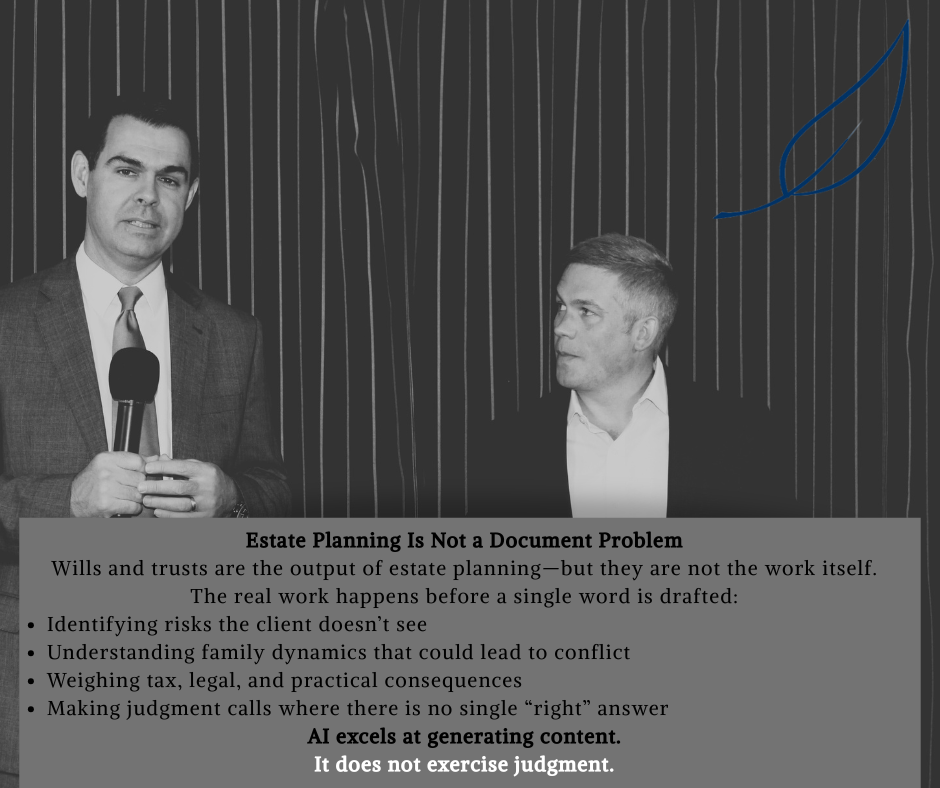
Estate Planning Is Not a Document Problem
Wills and trusts are the output of estate planning—but they are not the work itself.
The real work happens before a single word is drafted:
Identifying risks the client doesn’t see
Understanding family dynamics that could lead to conflict
Weighing tax, legal, and practical consequences
Making judgment calls where there is no single “right” answer
AI excels at generating content.
It does not exercise judgment.
Clients Don’t Know What They Don’t Know
AI is only as good as the prompts it receives.
Most people seeking estate planning help:
Don’t know which questions to ask
Don’t understand the long-term consequences of certain choices
Don’t foresee how life changes—remarriage, estrangement, disability, addiction—can unravel a plan
An experienced estate planning attorney doesn’t just answer questions.
They surface issues the client didn’t know existed.
That proactive guidance is what prevents disputes, litigation, and heartbreak later.
Estate Planning Is About People, Not Paperwork
The most common reasons estate plans fail have nothing to do with formatting errors or missing clauses.
They fail because of:
Unequal expectations among children
Second marriages
Undue influence
Capacity challenges
Family members who disappear—and reappear when money is involved
AI cannot:
Read the room
Detect coercion
Adjust strategy based on interpersonal dynamics
Sense when a plan will invite conflict
Attorneys do this every day.
Accountability Still Matters—Especially When Things Go Wrong
When an estate plan is challenged, courts don’t ask:
“Was this document well-written?”
They ask:
Who advised the client?
Was capacity properly assessed?
Was undue influence considered?
What professional judgment supported these decisions?
AI cannot:
Carry malpractice insurance
Testify in court
Be cross-examined
Defend its reasoning years later
Estate planning isn’t just about getting it done—it’s about being able to stand behind it when it’s questioned.
Regulation Will Shape the Future
Even as AI tools improve, the legal profession remains regulated for a reason.
Drafting legal documents without proper legal oversight raises issues of:
Unauthorized practice of law
Consumer protection
Ethical responsibility
The most likely future is not AI replacing attorneys, but AI-assisted attorneys—professionals who use advanced tools while remaining responsible for judgment, advice, and outcomes.
Our Approach: Technology + Human Judgment
We embrace technology that allows us to work smarter, faster, and more efficiently for our clients. But we never outsource judgment.
Estate planning requires:
Careful listening
Strategic thinking
Experience with real-world consequences
And the willingness to say, “This may be legally possible—but it’s not wise.”
That’s something no algorithm can do.
 The Bottom Line
AI may someday draft flawless legal documents.
But estate planning has never been about flawless documents.
It’s about defensible decisions, human judgment, and accountability when families and finances collide.
And that’s where experienced estate planning attorneys remain essential.
Concerned about whether online or AI-generated estate planning is enough for your family? Schedule a consultation to talk through your situation.

- Is Your Estate Plan Living in the Past? 10 Signs It May Be Time for an Update - September 1, 2026
- When Backup Language Matters Most: Lessons from the Reiner Estate Dispute - September 1, 2026
- Still Fighting: The Estate Planning Legacy of Shannen Doherty - July 16, 2026
